

Price: $749.99 $695.43
(as of 2026-11-12 01:16 GMT+0000 – Details)

Processor and AI Compute
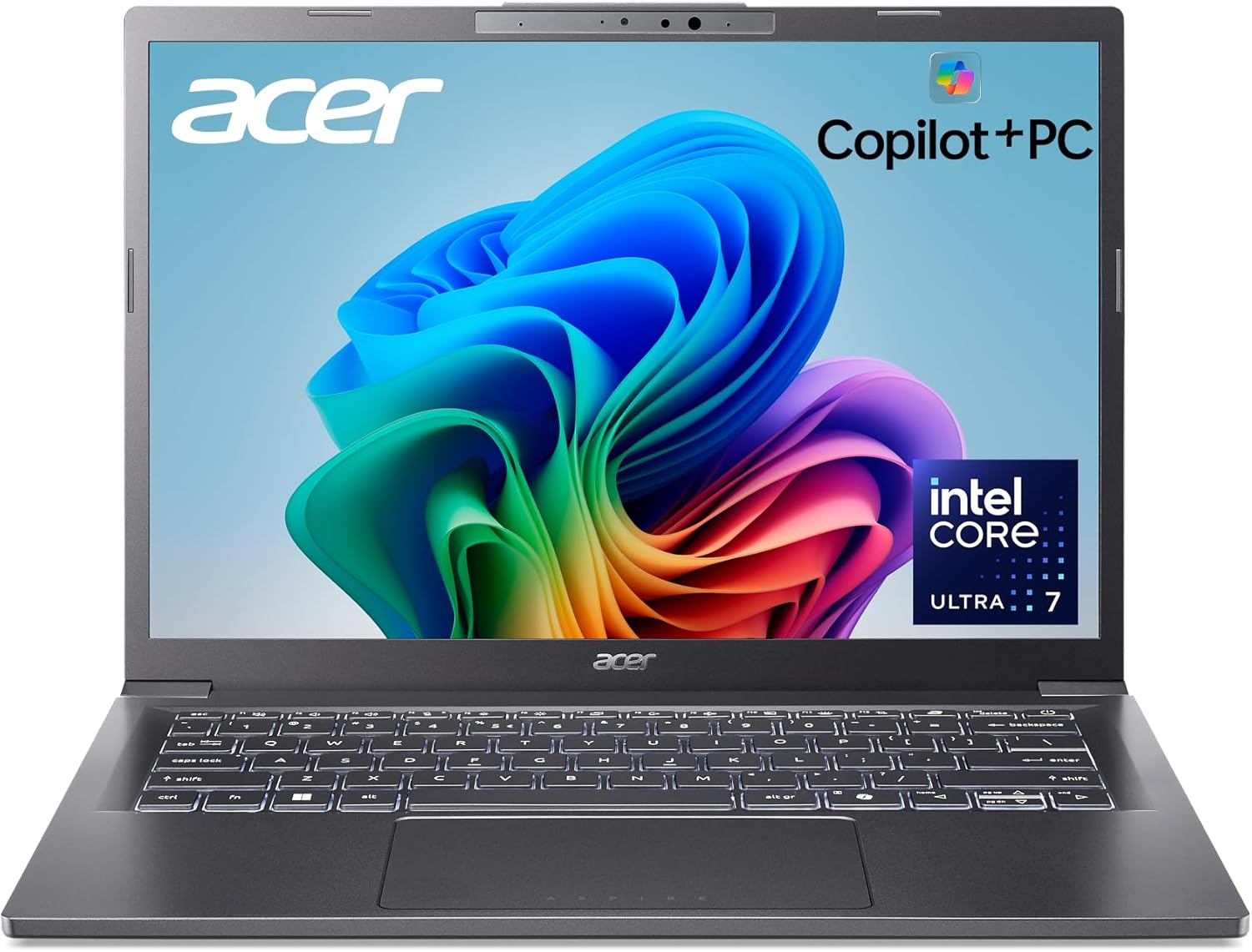
The Aspire 14 AI Copilot+ PC is built around an Intel Core Ultra 7 processor (Series 2) that integrates a CPU, GPU, and a neural processing unit (NPU) capable of up to 47 TOPS. The GPU portion, identified as Intel ARC 140V, can deliver up to 64 TOPS, providing a combined AI compute envelope that the manufacturer says can handle demanding inference workloads and accelerated graphics tasks. This heterogeneous architecture is intended to enable on‑device AI features such as real‑time language processing, image enhancement, and predictive scheduling without relying on cloud connectivity. The 16 GB of LPDDR5X memory and a 1 TB SSD supply the bandwidth and capacity needed for large model weights and fast data access.
Display
The 14‑inch WUXGA panel offers a 1920 × 1200 resolution in a 16:10 aspect ratio, giving a slightly taller canvas than traditional 16:9 screens. The manufacturer describes the display as “ultra high‑resolution” and “panoramic,” suggesting it is suited for multitasking windows, content creation, and media consumption. Because the panel is non‑touch and the specification does not list a refresh rate above 60 Hz, users should expect standard office‑grade motion performance rather than high‑refresh gaming fluidity. Color coverage and brightness figures are not disclosed, so professional color‑critical work may require external calibration or a secondary monitor.
Copilot+ AI Features
The Copilot+ PC branding brings a suite of Windows‑level AI tools that are still rolling out. According to the product description, features such as Recall (preview), an improved Windows search experience, and Click to Do (preview) allow users to retrieve past activity, perform natural‑language queries, and act on highlighted text or images directly from the interface. The rollout timeline notes that these experiences vary by device and market, with the European Economic Area receiving Recall and Click to Do later in 2025. Until the updates are delivered, the hardware’s NPU and GPU resources remain available for third‑party AI applications, but the full first‑party Copilot+ experience is not guaranteed at launch.
AcerSense and Keyboard
AcerSense is presented as a dedicated AI utility accessed via a physical key on the backlit keyboard. Pressing this key opens a dashboard that can adjust system performance profiles, enhance video‑conference framing, and apply noise‑suppression filters to the microphone input. The description emphasizes “intuitive AI that’s easy to use,” suggesting the software abstracts low‑level settings for non‑technical users. However, no details are given about the depth of customization, offline capability, or whether the utility can be replaced by standard Windows controls, so power users may find the feature set limited.
Chassis and Hinge
The chassis is described as a sleek, durable aluminum shell with a 180° lie‑flat hinge, enabling the laptop to be used in tablet‑like or presentation modes. The manufacturer highlights a lightweight design, though an exact weight figure is omitted, making it difficult to compare against competing ultraportables. The aluminum construction should provide rigidity and a premium feel, while the hinge mechanism adds versatility for collaborative work or media viewing. Potential buyers should verify the actual mass and thickness from a spec sheet, as “lightweight” can vary widely across 14‑inch models.
Battery, Connectivity, and Upgradeability
The quoted battery life of up to 22 hours is based on a video‑playback test under specific conditions, so real‑world mixed‑use scenarios—such as web browsing, AI inference, or video conferencing—will likely yield shorter runtimes. Connectivity includes Wi‑Fi 6E, which offers higher throughput and lower latency on compatible routers, but the absence of a wired Ethernet port may require a dongle for stable desk setups. The 1 TB SSD and 16 GB LPDDR5X provide ample storage and memory for large datasets and multitasking, yet the soldered memory prevents future upgrades. Overall, the platform delivers a strong AI‑centric hardware foundation, but the full software experience depends on pending Windows updates and regional feature availability.