


Price:
(as of Aug 04, 2026 07:36:46 UTC – Details)

Dell Pro 15 Essential: A Comprehensive Analysis of the Business-Ready Workhorse
In the current landscape of professional computing, the delineation between consumer-grade hardware and business-class reliability has become increasingly distinct. Professionals no longer simply require a device that turns on; they demand a machine that sustains performance through back-to-back video conferences, handles extensive spreadsheet modeling without latency, and survives the rigors of daily transit. The Dell Pro 15 Essential positions itself squarely in this arena, promising a blend of modern processing architecture, high-refresh-rate visuals, and a connectivity suite designed for the hybrid workforce. Based on the manufacturer’s specifications and feature highlights, this analysis dissects the capabilities, design philosophy, and practical utility of this Carbon Black workhorse.
Design Philosophy and Build Quality: The Carbon Black Aesthetic
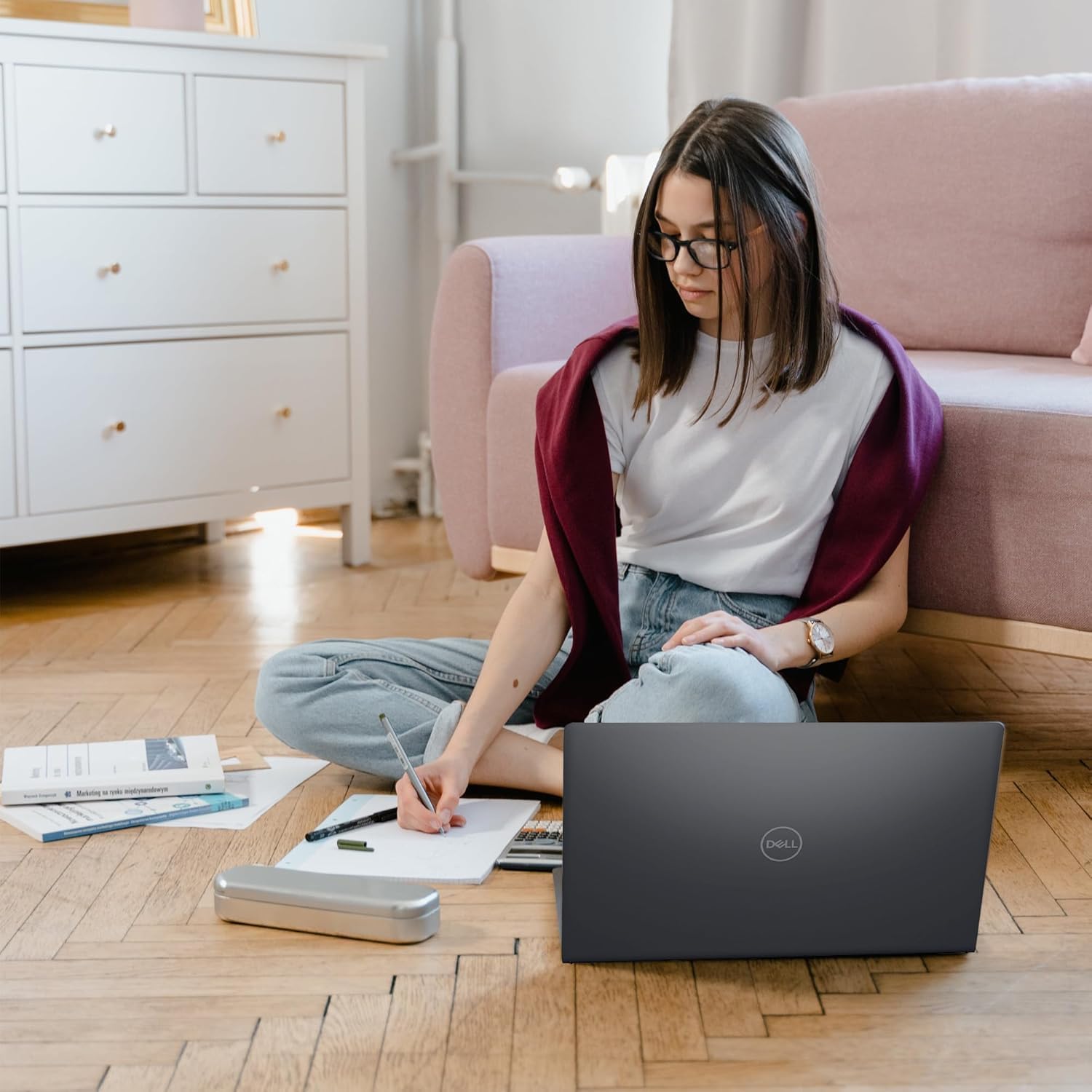
The first interaction with any business laptop is tactile, and the Dell Pro 15 Essential adopts a “Carbon Black” finish that signals professional intent. Unlike the flashy accents or aggressive geometries found in gaming-adjacent devices, this chassis embraces a minimalist, monolithic aesthetic. For the modern professional—whether walking into a boardroom, a co-working space, or a client site—the visual language is deliberately unobtrusive. It projects competence without demanding attention.
While the provided specifications do not detail specific MIL-STD testing ratings or chassis materials (such as aluminum vs. high-grade polymer), the “Essential” branding combined with the “Pro” moniker suggests a focus on structural rigidity necessary for “reliable daily use.” A 15.6-inch form factor inherently offers a larger footprint, which typically allows for better thermal dissipation and a more comfortable keyboard deck spacing compared to 13 or 14-inch ultraportables. The design priority here appears to be static stability—creating a device that feels planted on a desk yet remains portable enough for the commute.
Visual Experience: The 120Hz Advantage in Productivity
The standout specification on the front of the display panel is the 120Hz refresh rate. In the business laptop segment, 60Hz panels have been the standard for decades. The jump to 120Hz on a 15.6-inch Full HD (1920 x 1080) panel represents a significant quality-of-life improvement that extends far beyond gaming.
For the target audience—business professionals, remote workers, and entrepreneurs—the benefits are immediate and tangible. Text rendering during rapid scrolling through lengthy legal documents, code repositories, or financial models becomes noticeably sharper, reducing the “ghosting” or motion blur inherent in 60Hz panels. This translates directly to reduced eye fatigue during extended work sessions. The manufacturer highlights “smooth scrolling and crisp text,” and technically, the doubled frame rate allows the display controller to present new frames every 8.3ms versus 16.6ms, halving the sample-and-hold persistence blur.
The FHD resolution at 15.6 inches hits a “sweet spot” pixel density (~141 PPI). It is sharp enough for detailed UI work and multi-window snapping without requiring the fractional scaling (125% or 150%) that higher-resolution panels often necessitate, which can sometimes introduce rendering artifacts in legacy business applications. The panel supports the standard sRGB color space implicitly, suitable for general office productivity, presentation design, and video conferencing preview, though creative professionals requiring AdobeRGB or DCI-P3 coverage would need to look toward specialized mobile workstations.
Processing Power: Deconstructing the Intel Core 3 100U
At the heart of the system lies the Intel Core 3 100U processor. Understanding this specific SKU is critical to setting performance expectations. Based on the provided data—6 cores with a maximum turbo frequency of 4.7 GHz—this chip sits within Intel’s efficiency-optimized “U-series” (typically 15W-28W base power) architecture, likely utilizing a hybrid core design (Performance-cores and Efficient-cores).
The “6-core” configuration is a notable upgrade over the traditional 2-core/4-thread or 4-core/8-thread entries found in previous entry-level business chips. The inclusion of Efficient-cores (E-cores) allows the operating system (Windows 11) to offload background tasks—system updates, indexing, cloud sync clients, browser tabs idling in the background—to the low-power cores. This leaves the Performance-cores (P-cores) free to burst up to that 4.7 GHz ceiling for foreground tasks: launching heavy Excel macros, compiling code, rendering a PowerPoint deck, or encoding a video call stream.
The manufacturer claims “Enhanced Productivity” and the ability to “handle multiple applications simultaneously.” This is a realistic claim for the type of workload described: “spreadsheets, video calls, and presentations.” This is not a workstation replacement for 3D rendering, heavy video editing (DaVinci Resolve/Premiere Pro), or large-scale data science modeling. However, for the “knowledge worker” workload—characterized by bursty, integer-heavy tasks and high memory bandwidth demand—this architecture is highly optimized. The 4.7 GHz boost clock ensures snappy single-thread responsiveness, which is the primary driver of perceived “snappiness” in the Windows UI.
Memory Architecture: 16GB DDR5 – The Modern Baseline
The inclusion of 16GB of DDR5 RAM as standard is perhaps the most critical specification for longevity. For years, 8GB was the entry-level standard, forcing immediate upgrades for any serious multitasker. 16GB is now the functional minimum for a professional Windows 11 machine in 2024/2025.
DDR5 brings architectural improvements over DDR4 beyond raw bandwidth (typically 4800 MT/s or 5600 MT/s in U-series laptops). It features dual 32-bit sub-channels (vs single 64-bit in DDR4), improving memory access efficiency for multi-core processors like the Core 3 100U. It also integrates Power Management ICs (PMIC) on the DIMM itself, allowing for better voltage regulation and potentially slightly better battery life during memory-intensive operations.
The practical implication for the user is the ability to maintain a “working set” of applications open simultaneously: a browser with 20+ tabs (Teams, Slack, CRM, Research), Microsoft Office suite (Outlook, Word, Excel, PowerPoint), a local database or Docker container, and the OS overhead—all without hitting the page file (virtual memory on the SSD). Hitting the page file on an NVMe SSD is fast, but it introduces latency spikes that break flow state. 16GB DDR5 effectively eliminates this bottleneck for the intended target audience.
Storage Subsystem: 512GB NVMe SSD
The 512GB Solid State Drive provides the “lightning-fast boot times” referenced in the product description. While the spec sheet does not explicitly state “NVMe” or “PCIe Gen 4,” a modern Intel Core Ultra/Core Series 1 platform paired with DDR5 memory almost exclusively utilizes PCIe NVMe interfaces. This ensures sequential read/write speeds typically exceeding 3,500 MB/s (Gen 4) or 7,000 MB/s (Gen 5), vastly superior to SATA SSDs of the past.
For the business user, 512GB represents a pragmatic balance. It accommodates the Windows 11 OS (~30-40GB), a full suite of professional applications (~20-50GB), and a substantial local working library of documents, assets, and offline email caches (~100-200GB), leaving ample headroom. The “Essential” positioning suggests this is a primary device, not a thin client; therefore, local storage speed directly correlates to application launch times and file save/open dialogs. The spec sheet also notes “ample storage,” acknowledging that while 1TB is preferable for media-heavy roles, 512GB is the standard for document-centric workflows, especially with cloud integration (OneDrive/SharePoint) handling the heavy lifting for archival.
Connectivity: The Hybrid Work Hub
The port selection and wireless specification reveal a clear design thesis: One cable to rule the desk.
Wireless: Wi-Fi 6 (802.11ax)
The inclusion of Wi-Fi 6 is non-negotiable for a 2024/2025 business laptop. The spec sheet cites “stable video conferencing and reliable cloud access.” Technically, Wi-Fi 6 offers OFDMA (Orthogonal Frequency-Division Multiple Access) and MU-MIMO (Multi-User, Multiple Input, Multiple Output), which dramatically improve performance in dense environments—open-plan offices, airports, coffee shops, or apartment complexes where the 2.4GHz and 5GHz bands are saturated. For a remote worker on a video call, this means lower jitter and packet loss, even when a partner is streaming 4K video in the next room. It is worth noting the absence of Wi-Fi 6E or Wi-Fi 7 (which utilize the 6GHz band), but for “Essential” tier hardware, Wi-Fi 6 remains the robust, proven standard.
Physical Ports: USB-C and HDMI
The spec sheet lists “USB-C and HDMI” under ports. This is a curated, minimalist selection.
- HDMI: The inclusion of a full-size HDMI port (likely HDMI 1.4b or 2.0) is a deliberate pro-business decision. It allows direct connection to projectors in meeting rooms, hotel room TVs, or legacy external monitors without carrying a dongle. This reliability is paramount for “professional presentations.”
- USB-C: This is the modern workhorse port. On an Intel U-series platform, this port almost certainly supports USB 3.2 Gen 2 (10Gbps) data, DisplayPort Alt Mode (video output), and USB Power Delivery (charging). This single port transforms the laptop into a desktop replacement: one cable to a monitor dock provides power, video to dual external displays (via MST on the dock), Ethernet, and peripheral connectivity (keyboard, mouse, webcam).
The absence of legacy USB-A ports, an Ethernet jack, or a microSD reader on the chassis itself (based solely on the provided list) signals a forward-looking stance. The assumption is that the user either operates wirelessly or utilizes a USB-C hub/dock. For the “entrepreneur” or “remote worker” moving between locations, carrying a compact multi-port hub is lighter than the legacy ports would make the chassis.
Software Environment: Windows 11 Optimized
Shipping with Windows 11 ensures the hardware scheduler (Thread Director) functions natively with the hybrid Core 3 100U architecture. Windows 11’s ability to intelligently assign threads to P-cores vs E-cores is a hardware-software dependency; running Windows 10 on this silicon would yield suboptimal battery life and multitasking smoothness. The OS also brings native support for features critical to the spec sheet’s promises: Snap Layouts for the 15.6″ screen real estate, Teams integration for the “video conferencing” use case, and modern standby/resume for the “reliable daily use” promise.
Target Audience Alignment
The manufacturer explicitly identifies the target: “business professionals, remote workers, entrepreneurs, and anyone requiring a reliable laptop for productivity tasks, video conferencing, and professional presentations.”
- The Corporate Deployer: Will appreciate the standard chassis (likely easy to service/image), Windows 11 Pro eligibility (implied by “Business Laptop” branding), and the HDMI port for hot-desking.
- The Remote Worker: Benefits most from the 120Hz screen (eye comfort at home), Wi-Fi 6 stability, and the USB-C single-cable docking capability.
- The Entrepreneur/Small Business Owner: Gets a “Professional Ready” aesthetic (Carbon Black), sufficient local horsepower for QuickBooks/CRM/Design tools, and a price-to-performance ratio that the “Essential” tier implies.
It is equally important to note who this is not for, based strictly on the specs: It is not a mobile workstation for CAD/CAE (no discrete GPU, U-series thermals). It is not a content creation studio laptop (likely limited color gamut, no SD slot). It is not a ruggedized field device (no IP rating or MIL-STD mention in provided text).
Verdict: Defining “Essential” in the Modern Era
The Dell Pro 15 Essential does not chase headlines with folding screens or AI co-processors (NPU TOPS are not mentioned in the provided specs). Instead, it executes a focused strategy: eliminate the friction points of daily office work.
The 120Hz display removes visual friction. The 16GB DDR5 / 512GB NVMe combo removes memory and storage friction. The Core 3 100U’s hybrid architecture removes processing friction for bursty workloads. The Wi-Fi 6 and USB-C/HDMI duo removes connectivity friction.
In a market saturated with compromises—8GB soldered RAM, 60Hz dim panels, single USB-C ports with no video out—this configuration reads as a carefully curated “anti-compromise” package for the mainstream professional. It respects the user’s need for a large, comfortable screen and a full-size keyboard layout (implied by 15.6″ chassis) while delivering the modern internal specs (DDR5, PCIe Gen 4 storage, Hybrid CPU, High Refresh Rate) that ensure the device remains viable for a standard 3-to-4-year refresh cycle.
For the buyer evaluating this against the “Essential” name: the specifications suggest that Dell has defined “Essential” not as “bare minimum,” but as “fundamentally correct.” It is a machine built not to impress in a spec sheet comparison, but to disappear into the background of a productive workday—which is, ultimately, the highest praise a business tool can earn.