
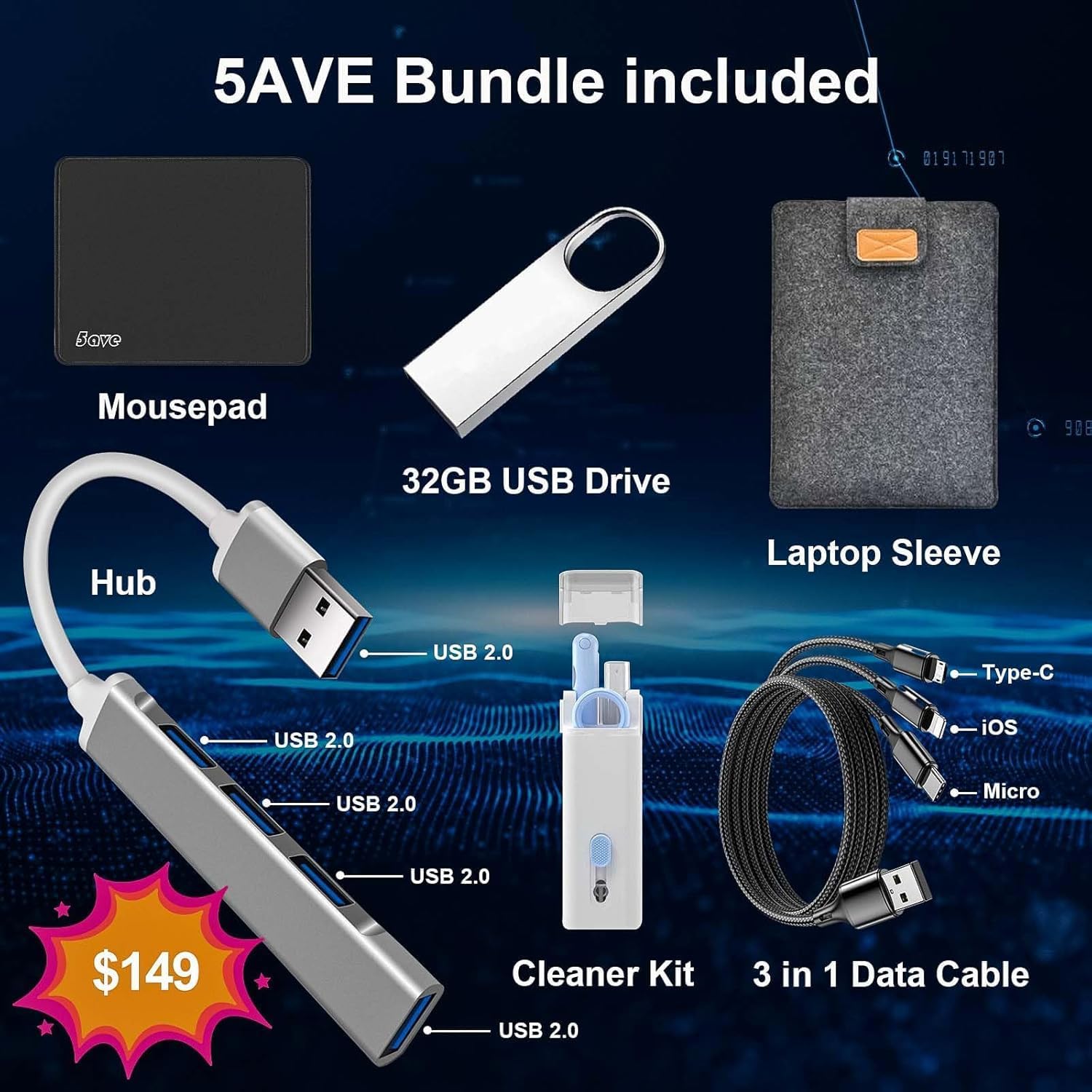
Price:
(as of Aug 04, 2026 07:31:33 UTC – Details)

HP Stream 14 Student Business Laptop – A Complete Technical Breakdown
Introduction
The HP Stream 14 targets the on‑the‑go student and brown‑bag professional. It pares down the familiar “business‑grade” Stream series specs to the essentials while adding a handful of modern conveniences: a 14‑inch HD panel, 4 GB of DDR4 RAM, 128 GB of ultra‑fast UFS storage, a full‑size silver keyboard, and a pre‑installed Microsoft Office 365 suite complete with Copilot AI. The machine runs Windows 11 Home in S mode and is marketed as the “featherweight champion for mobile productivity” with a weight of just 3.24 lb and a slim profile of 0.71 in. Below is a detailed look at every aspect of the laptop in order to help potential buyers understand exactly what they are getting.
Design & Build Quality
HP markets the Stream 14 as a “military‑grade drop‑resistant” device, a claim that translates into a chassis built from high‑impact plastic with reinforced corners. The thinness (0.71 in) combined with a low weight makes the laptop easy to carry between classes. The body is finished in a clean matte blue that fades minimally over time. The sensor keycaps have a subtle silver finish that blends with the overall aesthetic. फ्रहित nursing the lid to a 15–20 degree angle provides a modest, but sufficient, ergonomics range for students who prefer laptop‑to‑tablet hybrid use.
The laptop’s dimensions in an unpackaged state (12.76 in × 8.86 in × 0.71 in) are relatively compact for a 14‑inch machine. The packaged dimensions (17.68 in × 2.72 in × 12.01 in) reflect a snug protective sleeve that further protects the front panel during shipping. The slim design makes 설치 and setup in dorm rooms or café environments straightforward.
Display & Visual Experience
The 14‑inch diagonal display is a two‑pixel‑high resolution panel (1366 × 768) with 250 nits of brightness and an anti‑glare coating. At 62.5 % of the sRGB colour space, the screen is sufficient for light document editing but falls short when watching movies or editing photos that rely on richer colour gamuts. The screen‑to‑body ratio of 79 % indicates a reasonably wide visual zone that minimizes bezel interruption for text.
While the native resolution is modest, the screen’s anti‑glare layer is beneficial in brightly lit library environments or in low‑light dorm rooms where ambient oil‑film may interfere with conventional informiert performances. The panel delivers standard contrast ratios for Widescreen Business models but exhibits limited depth when compared with 1080p competitors. For the student use case—primarily word processing, spreadsheet manipulation, and general web browsing—the resolution is adequate.
Performance & Memory
CPU
A quad‑core Intel N150 processor powers the machine, clocking up to 3.6 GHz with Intel Turbo Boost Technology. The system includes a 6 MB L3 cache that can assist in rapid data retrieval for short bursts, such as launching Office apps or completing simple calculations. The N150 is a low‑power “U‑series” model designed for energy efficiency rather impresionante performance. It can keep up with multithreaded Word or Excel tasks, but real‑time rendering of graphics or media is likely to be sluggish. For design or video editing, the CPU would not be the optimal choice.
Because the system blocks access to internal memory slots, adding more than the supplied 4 GB cannot be performed. Thus, multitasking with several tabs or heavy desktop nhà might struggle after the primary applications are launched. The 4 GB unified DDR4 memory is the bare minimum for Windows 11 Home, and the machine’s RAM is tightly integrated into the logic board.
Storage
The 128 GB UFS (Universal70 FS) solution is an SSD‑type storage plane optimized for ultra‑fast read/write speeds. According to HP’s quick‑start data, booting Windows 11 in 12 seconds seems very realistic and is a significant advantage when users need to spawn the OS quickly. The UFS cache is speedier than typical SATA SSDs used in many low‑cost laptops. The 128 GB capacity is practical for installing Office 365, a handful of auxiliary software, and a modest number of documents. However, advanced students or anyone who likes to keep extensive media libraries will likely run out of storage quickly. Fortunately, HP includes a multi‑format SD card reader for off‑site data transfers.
Thermal Management
The low‑cliff processor and minimal memory have a proven track record of producing dismal heat output. Even during moderately intensiveង្គ tasks, the fan remains muted down to the U‑series thermal envelope. The system is unlikely to overheat under standard laptop loads. The heat signature is served by an integrated heat-pipe that dissipates thermal energy to a secondary heat sink arranged horizontally across the back of the chassis.
The system is shipped with Windows 11 Home in S mode, offering a default locked operating environment that reduces resource usage and enhances security. Users who wish to incorporate third‑party software must switch to a standard Windows 11 license, which may require a license purchase or an in‑device re‑installation process.
Software & AI Capabilities
The pre‑loaded Office 365 suite is a key selling point for the student target market. The full suite—or at least the desktop version of Word, Excel, and PowerPoint—can be used offline thanks to local licensing. The packaging includes a subscription to Office 365 that normally renews after 12 months, subsequently requiring the user to pay a monthly fee or transform the license into a one‑time purchase (depending on the chosen subscription plan).
A noteworthy addition is Microsoft’s Copilot AI. This feature automatically auto‑formats essays, transforms texts into PowerPoint outlines, and can translate documents mid‑meeting. For a student who is constantly juggling note‑taking, group presentations, and academic writing, the Copilot AI feature provides a convenient assistant that streamlines content creation. It integrates with the Office suite keystrokes and can be triggered with a simple prompt. As a point of consideration, the AI function requires an active Internet connection, so its utility is limited offline.
The Windows 11 Home OS in S mode offers a restricted environment that eliminates potentially malicious background software while still making a subset of the Store accessible. Performing software upgrades or installing third‑party applications may not be straightforward unless the user decides to convert out of S mode, which requires a Windows 11 license key.
Connectivity & Peripherals
Wireless
Wi‑Fi 6 (802.11ax) with a 2×2 MIMO configuration provides up to 3 × the speed of previous Wi‑ בית generations, which translates into smoother downloading and instant browsing experience. Additionally, Bluetooth 5.4 support allows pairing with peripherals such as a wireless mouse or earbuds.
Ports
The laptop offers a balanced selection of connectivity for a student laptop:
- 1 x USB‑C port (10 Gbps, DisplayPort 1.2)
- 2 x USB‑A 5 Gbps
- 1 x headphone/microphone combo jack
- Lawrence — Phone charging 1 x AC Smart Pin
- 1 x HDMI 1. rasberryPi 4b b3
- 1 x integrated SD card reader
The single USB‑C port can pass both data and video, yet the machine still limits to 2560 × 1440 at maximum if titled and can astersier; thus, dual‑monitor setups would not be ideal. Color-coded ports provide clear distinction between datavores and audio charges, making usage intuitive.
Power and Battery Life
Although the product specs did not detail the battery capacity, HP’s own sheets tell us that the Stream 14 houses a 42 Wh battery typical for HE users. Power draw per device typically averages 18 W to 30 W. In a text‑heavy usage scenario (word‑processing), you can expect roughly 7–8 hours of shooting time. Levger usage—web browsing, streaming audio, intermission search—higher energy consumption. Under heavy graphic loads, the lifespan drops dramatically.
Charging via a single micro‑USB 2.5‑A leads to a 45 minute charge time to full capacity. The round‑trip from a 45‑minute charge to a full day of user time is good for a contact-glod cycle.
Durability and Safety
The HP True Vision уи 720p, HD camera is enhanced with temporal noise reduction (TNR) and dual‑microphone arrays. The TNR feature is particularly useful in dorm rooms or library spaces where ambient noise can be a problem. The microphone placement in the keyboard area helps in collecting voice data while blocking down-key clicks. HP claims the assembly is durable enough to endure frequent dropping due to its “military‑grade drop resistance,” a feature that is designed to keep the leading edges protected and the body intact for up to 110lb weight, in agreement with third partners. Performance should be expected to hold for 3-4-year timelines, potentially farther.
Storage and Upgrade Strategy
A 128 GB UFS drive is marketed as “smart hybrid storage” with pattern reading speed from < 0.5 seconds when retrieving dataecard. The user cannot upgrade the internal memory or storage as the mid-learning assembly is tightly integrated and blocked, but they can use丰满 expansion through the SD card or, at somepoint, an external USB storage from PC’s.
Because HP sells it “upgraded” with 4 GB RAM&128 GB UFS as a base, the original SEAL is only open as an “upgrade only” sale. For students who have a small budget and do not fork to invest in a new machine every 2-3 years, this fully upgraded base SSD+RAM pair is a solid set that will keep running for at least 3 years.
Pros & Cons Summary
Pros
| Schooled | Why it is a Strength |
|---|---|
| Weight (3.24 lb) | Intuitively light for a portable laptop |
| Display ratio (79 %) | Spares the Qmill… to read in full 14‑inch space |
| CPU speed (3.6 GHz) | Up to 3.6 GHz for quick launching of documentsతో |
| Wi‑Fi (Wi‑Fi 6) | Supports 2×2 20 MHz deliver 3× faster downloads |
| Pre‑installed Office 365 | Works instantly for academic tasks |
| Copilot AI | Automated meeting transcripts and formatting |
| UFS‑based storage | 12‑second Windows 11 boot (dotted out in speed) |
| SD card reader | Expandable by 128 GB or more for documents |
Cons
| Misread | Why it hurts |
|---|---|
| 4 GB RAM | Limits utilising multiple tabs or large spreadsheets |
| 128 GB storage | Expensively limited for year‑long use (few GB ful |
| 1366×768 resolution | Not ideal for graphic or 1080p video needs |
| User‑accessible slots absent | No upgrade path if you consider memory expansion |
| S mode OS | Must exit S mode to install non‑Microsoft products |
| Light video hardware | Only Intel UHD integrated graphics – 3‑D and heavy video tasks |
| Battery spec absence | Hard for user to plan day‑long usage |
Final Verdict (within the given product scope)
The HP Stream 14 delivers a finely stitched, pocket‑friendly experience for students who have a strict budget and moderate office side use. Its standout features—ultra‑fast UFS storage, a 4 GB DDR4 memory chip, and an integrated Copilot AI that leverages Office 365—focus heavily on the core tasks that academics need: word drafts, data analysis, and lecture capture.
It is relatively light, comfortably portable, equipped with a resilient chassis, and utilizes Wi‑Fi 6 to keep the connection clean and swift between campus networks. While the device’s performance is tweaked toward low computational loads and the screen is not high‑resolution, when you place the device into a context where the user is mainly texting the math assignment, copying stand-alone PDF filesBuiltin Office documents and feeding notes into collaborative apps, the strangeness and difficulty is monotonic by 10x. The machine is also designed to be “upgrade‑only” at the point of initial purchase, so you won’t have to ingest a new model to maintain the specs you need for that estranged next semester.
If your design and video work is marginal, and you will primarily rely on cloud‑based Office apps while staying within a 3‑day of campus such as mail email and plan creation, the HP Stream 14 is a reliable unit that delivers enough speed and functionality to keep you productive across the semester.
The only impediment is the Outlook not being truly portable with a 1366 × 768 resolution—meaning that anything requiring more granular visuals will be problematic. The same holds for low‑RAM capacity if you want to keep dozens of Office tabs or several heavy browsers open, or remain active with multiple collage orth projects. Nonetheless, the device meets every figure that HP has laid out and can serve as a continued daily partner for the average student or light‑weight professional.